Monday, April 18, 2011

NC Computer Systems supports ASLI with Alibre Design

Alibre Design has been an essential component of ASLI’s engineering program since our inception in 2007, and has provided us with a powerful & flexible 3D CAD system. Alibre Design empowers our team from concept through to manufacture of high performance aerospace components & systems, which ASLI use to drive excellence in student academic achievement.

Cross section illustration of the ASLI R.A.S.T.A test vehicle produced in Alibre Design v12

“ASLI has a diverse team of volunteers & student participants coming from many different engineering streams, so it was critical to have a design package that was easy to learn while not sacrificing on capabilities. It was also a key requirement that the software enabled our team members to rapidly share & revise concepts, as well as meeting the need to communicate our designs to our different manufacturers CAD/CAM systems. Alibre Design more than meets our requirements allowing even our most CAD novice team members to quickly gain expertise, whilst delivering accurate engineering models & supporting multiple industry standard export file options.” Jamie Anderson ASLI Program Manager

Cross sectional drawing of hybrid rocket motor

Image finished motor parts

In 2010 we formed a new partnership with NC Computer Systems for the supply & support of Alibre Design, which we plan to profile in the Australia education sector through exposing schools & students to Alibre Design.

About Alibre

Alibre Inc. offers the industry's most affordable complete engineering solutions. Founded in 1997, Alibre Inc. is led by visionaries who sought to change the landscape of 3D mechanical CAD/CAM software by providing full parametric CAD technology to anyone that needs it, versus only to those in the relatively unique financial position to afford traditional CAD systems.

The CAD industry is unique in that the many products which make it up together represent one of the most significant advancements in the history of design. The technology makes the lives of everyone better by allowing safer, highly advanced, and substantially ambitious products to come into existence. The industry is not unique in the fact that over time the price for the technology has come down. Beginning with ComputerVision in the 70's, the price for the technology started at around $1,000,000. Catia in the 80's realized a $100,000 price tag. Pro/E at the end of the 80's saw a $20,000 price tag. Solidworks continues the trend in the 90's with $5000 per seat costs. And Alibre comes in to deliver the same technology starting at $99. The era of exclusivity for advanced design software is over.

Based in Richardson, Texas, USA, Alibre delivers affordable design solutions to tens of thousands of businesses and individuals in over 50 countries and in over 15 languages.

www.alibre.com

About NC Computer Systems

NC Computer Systems has been established since 1979. This equals 31 years of experience in the production and distribution of cutting edge softwares for the manufacturing industry. Over the years, we have offered CAD/CAM and manufacturing solutions to over 500 Australian and New Zealand companies.

NCCS has built its reputation and business by providing an outstanding service, comprehensive knowledge and superior quality products at affordable prices.

We have a wide range of customers throughout Australia and offer solutions to program most of the CNC machines including Milling, Turning, EDM, Plasma, Laser, Punch and powerful communication software for CNC controllers.

www.ncss.com.au


Thursday, April 7, 2011

ASLI forms a new partnership with Kinetic CNC

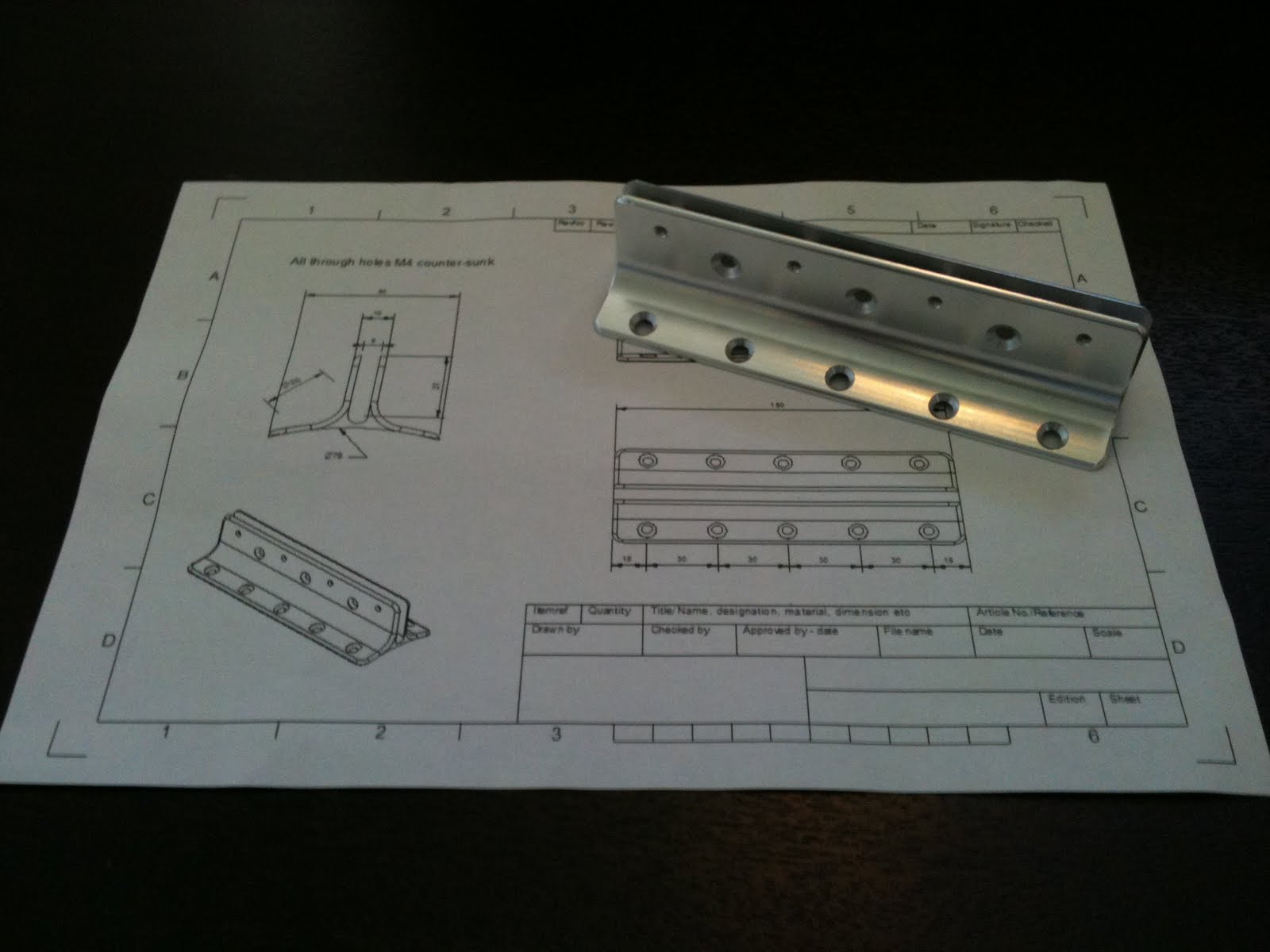
Kinetic CNC is a manufacturer of precision machined components based in Lawnton Queensland. The company has agreed to produce components for ASLI’s Pathfinder rocket program under sponsorship. The first of the prototype components were delivered to ASLI this week, & consist of conformal fin attachment brackets. The brackets are made from a 6000 series aluminium alloy; which allows us to attach the fins to the composite airframe by way of bolts. This allows rapid assembly of the airframe and field replacement of any damaged fins.

Prototype conformal fin attachment bracket produced by Kinetic CNC

Designs are communicated easily to Kinetic through data export from our Alibre Design software provided by NC Computer systems, which allows for high quality rapid prototyping services to our specifications.

“The support of Kinetic CNC has allowed us to make tangible improvements to many components of the Pathfinder rocket; their CNC equipment & experience gives them the ability to manufacture our components to higher tolerance and repeatability than we could achieve by manual machine labour. This has allowed us to realise reductions in component weight which is critical to extending the flight performance of our rockets, whilst also creating opportunities for mass production of precision rocket parts. Kinetic also bring extensive experience & expertise in prototyping and composite mould manufacture, which makes them a great partner for our program”. Jamie Anderson ASLI Program Manager

More on Kinetic CNC

Kinetic CNC is an Australian family owned and operated toolmaking and precision CNC machining company in Brisbane. It traces its roots back to 1994 in South Africa, where it was known as Kinetic Designs. The core motivation of the company is to supply outstanding quality at competitive prices. We are capable of providing a full design and detail package along with CNC manufacturing of components or tooling. Kinetic CNC has produced components and tooling for a wide range of industrial and commercial applications, including automotive, military, medical, packaging, electronic, hi-tech sports equipment, mining and aerospace fields.

Kinetic CNC makes a point of working as closely as possible with customers throughout the manufacturing process. This allows their ideas to be coupled with our extensive manufacturing experience, which streamlines the progression from concept to realisation. This is of particular value in prototype development where modifications in design are inevitable to achieve the desired outcome. In these supplier-customer dealings we pride ourselves in maintaining ethical relationships and customer confidentiality.

Monday, August 30, 2010

CST Composites Produces First Airframe Tube

CST Composites an innovator in the production of filament wound composite profiles has completed production of its first airframe set for ASLI. The 156mm diameter tubing designed specifically for the Pathfinder 1B rocket by University of New South Wales (UNSW) undergraduate student Jendi Kepple, underwent a rigorous design phase including the use of software finite analysis to optimise the laminate structure. This process combined with CST’s unique ability to precisely control fibre orientation during manufacture, have resulted in an airframe significantly lighter & stronger than current commercially available products.

CST Composites is a major contributor to our program; by utilising their knowhow in advanced composites we have being able to exceed the original design goals for the Pathfinder 1B rocket, realising a much lighter & stronger airframe with increased reusability over our first generation rocket. Jamie Anderson ASLI Program Manager

The airframe set consist of a carbon/epoxy filament wound lower airframe & a glass/ epoxy filament wound payload compartment fairing, which will be used to construct the first rocket for launch by January 2011.

UNSW Student Jendi Kepple & Carbon Fiber Aiframe Winding

Saturday, February 13, 2010

UNSW Student Project Report

Two forms of analysis were carried out in order to ensure that the Pathfinder 1B Rocket airframe would withstand the specified loading. The first was hand calculations and the second was by building a model in Patran. Once the hand calculations ensured that the airframe laminate was capable of withstanding the loading criteria, a second opinion was sought from Patran.
To start off, a geometrical model of the rocket was created and 71 different coordinate systems added in order to align the fibres in the appropriate direction. Patran then enveloped the model in an adequate mesh using a total of 4220 nodes to completely encase the structure. Thirdly, the forces acting on the rocket (such as drag, weight, thrust and internal pressure force) were multiplied by a factor of 2 (to ensure an appropriate factor of safety was reached) and added to the model. The properties of carbon fibre/epoxy and fibreglass/epoxy materials (such as transverse and longitudinal modulus) were added into Patran and a three layer composite laminate was designed. A simulation was run and results for deformation and maximum stress emerged.


The simulation successfully calculated that the rocket would not deform extensively or fracture under the given loading. The design of the 1.8mm-thick three ply laminate would be able to withstand the calculated flight path of the rocket.

Sunday, February 7, 2010

Pathfinder 1B

Pathfinder 01-B Launch Vehicle
Several key technical improvements have been identified in the first generation rocket design, and so a revision has been designed with the purpose of increasing the reusability of the rocket airframe. The Improved design has been designated Pathfinder 1B and makes more extensive use of composite materials, and greater modularity allowing for in-field replacement of critical components such as the fins.


The Pathfinder rocket provides a unique and completely safe platform for student and academic researchers, seeking a true “hands on experience” of space mission style operations. Being 100% free of any explosive propellants, toxic chemicals, electric matches & other pyrotechnic devices commonly used in rockets. Payload user teams are allowed unprecedented access to the rocket all the way up final propellant loading, and commencement of launch operations. Which are managed by ASLI team members, further insuring risk free participation for student & academic researchers.


Illustration of baseline trajectory using the ASLI H100N hybrid rocket motor.

Tuesday, January 19, 2010

ASLI announces new partnership for composite airframe materials.

ALSI is relaunched in 2010 with the formation of a new partnership with NSW Company CST Composites, the University New South Wales (UNSW) & the Co-operative Research Center for Advanced Composites Structures (CRC-ACS).

Under this partnership new airframe materials for the Pathfinder 1B will be designed for ASLI by UNSW undergraduate student Jendi Kepple from UNSW, and manufactured using CST advanced filament winding technology.

The formation of this new partnership allows ALSI to aggressively target a launch of the completed Pathfinder 1B rocket for 2010, paving the way toward solicitation of new student payload programs in 2011.

About CST

CST composites or ‘Composite Spars and Tube’ as it was originally known was founded in 1995. From its inception the company has focused on the design and manufacture of cost effective yet high quality filament wound tubing to service the Marine, industrial and high-tech markets.
In the early days activities were focused in the marine market where CST worked closely with development classes such as the 12’ skiffs to produce carbon spars that were strong, responsive, light and reliable. Since then the company has grown consistently year upon year, broadening its applications into the industrial and high tech Sectors. The company employs 24+ staff in a 1000sq M high tech facility in Kurnell, Sydney Australia. To date more than 1200 spars have been supplied and over 15,000 tubes have been manufactured.
The strength of CST lies with its unique filament winding technology which has been developed and evolved since 1995. Today the company now runs three filament winding machines and two pultrusion machines giving a production capacity capability of more than 20 tonnes of composite per year. CST is now the largest user of carbon tow in Australia and New Zealand. Our tubes and profiles are exported worldwide with significant markets in Europe, USA, China and Asia.

www.cstcomposites.com

About CRC-CS

The primary aim of the Cooperative Research Centre for Advanced Composite Structures (CRC-ACS), or Composites CRC, is to provide a focus for the development of advanced technologies which foster the growth of an efficient, globally-competitive, Australian composite industry.

This is achieved by conducting research and development programs into the design, manufacture, testing, durability and supportability of advanced composite structures.

The Composites CRC brings together skills from some of Australia's leading research providers to support its own core staff of thirty research engineers, scientists and technicians.

These highly skilled experts work with industry to develop new technologies to improve the cost-competitiveness and structural performance of composite materials in an ever expanding market place.

www.crc-acs.com.au

Thursday, July 23, 2009

Welcome

Intro here